
It’s Me!
Voices After the Face
by April Liu, April 22, 2026
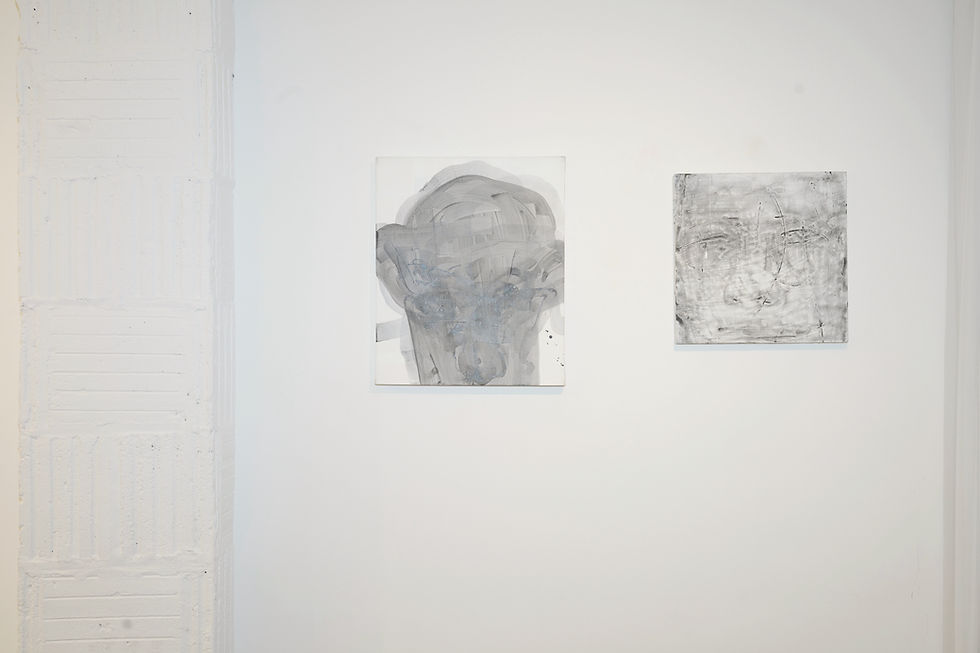
Installation view of After the Face. Photo by Weican Wang. Courtesy of the artist and CHINCHINART.
In After the Face, curated by Shuhan Zhang at Flohaus Gallery, the artists are here all the time. Their faces are here, and in a way that already counts as presence. A face can pass an ID check, complete an online verification process, satisfy a system asking for proof and move on. “It’s me,” the face says, and in many situations that is enough. This exhibition stays with the uneasiness inside that condition. The face appears first. Recognition follows almost immediately. Something more private, unstable, and difficult to name continues to hover just beyond it.
That tension runs quietly through the whole show. Faces emerge through paint, reflection, blur, and atmosphere. Eyes, mouths, contours, and expressions remain visible enough to register a person, yet clarity never fully settles. Emotion, meanwhile, arrives without much delay. Sorrow, hesitation, anxiety, self-consciousness, and vulnerability all remain close to the surface. The works keep these feelings present without pressing them into full explanation, and the gap between being identified and being understood gives the exhibition its shape.
In Hongyu Zhang’s paintings, emotion gathers quickly. Layers of acrylic and dragged brushstrokes hold the face in a suspended state, as though the image were still forming while already beginning to dissolve. Features come forward, then loosen again. A face remains there throughout, though it never hardens into certainty. What lingers most is the sensation of someone close to sobbing, or caught in the effort of holding emotion in place. These paintings stay with that unstable threshold and allow feelings to remain unresolved.
Aubrey LaDuke’s Mirror paintings bring the question of the face into a more intimate register. Reflection offers no final assurance here. Under sustained looking, the face begins to shift. A slight asymmetry, a softness in the skin, a detail that might pass unnoticed in ordinary life starts to expand under scrutiny. These works understand the quiet cruelty of self-perception, the way a face can become unsettled simply through prolonged attention. Their scale matters. Everything feels close, contained, and held in a private psychological space.
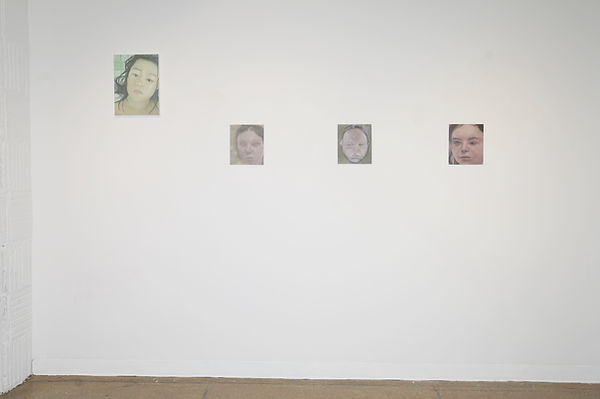
Installation view of After the Face. Photo by Weican Wang. Courtesy of the artist and CHINCHINART.
With Wendy Wei, inner life moves outward into objects and fragments of the everyday. Familiar things carry embarrassment, desire, tenderness, and estrangement all at once. Nothing feels merely descriptive. The paintings hold onto the subtle ways emotion attaches itself to surfaces, gestures, and ordinary materials, turning them into extensions of a psychic world that remains partly withheld. The face is still present in this space, though it no longer bears the full burden of subjectivity on its own.
Weican Wang’s works open the exhibition into a softer and more porous field. Blur, atmosphere, and botanical surroundings loosen the body’s edges and let presence drift across the image. Selfhood seems lightly held here, shaped by contact with environment, mood, and passing sensation. These works extend the exhibition’s central concern beyond facial appearance and into a broader sense of how a person can remain present while never becoming fully fixed.
The idea that the face resembles the heart lingers throughout the exhibition. Faces fill the gallery, carrying vulnerability, projection, judgment, recognition, and misunderstanding with them. Full access never arrives. The works leave room for opacity, for partial knowledge, for the distance that remains even when a face is right there in front of the eye. By the time the exhibition falls away, even a reflection in a phone screen or a darkened window feels slightly less secure. “It’s me” still stands as a statement. Its certainty no longer feels complete.
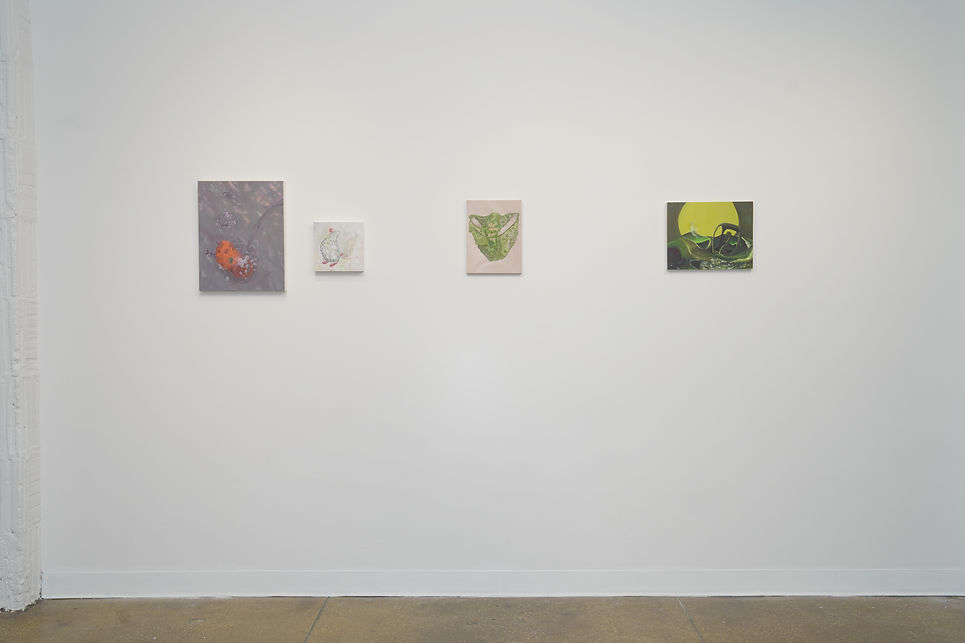
Installation view of After the Face. Photo by Weican Wang. Courtesy of the artist and CHINCHINART.