
THE BOOMERANG EFFECT
“Erased de Clowning”Curtis Mitchell at Alex Berns
By Gwenaël Kerlidou, April 2, 2026
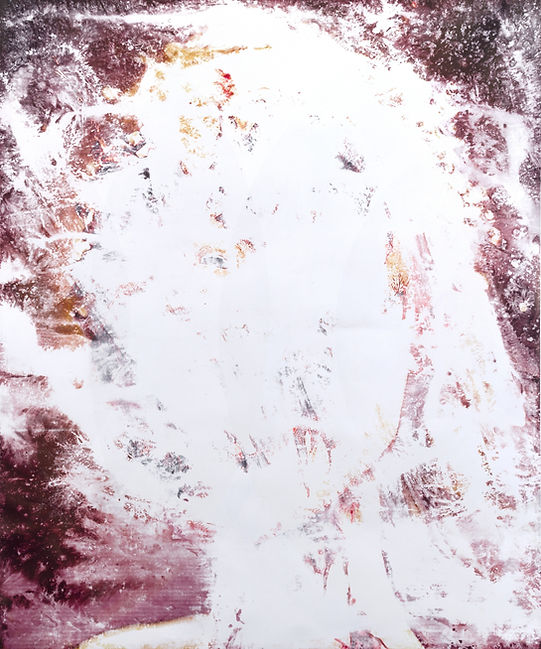
Laugh, 2026, Giclée print, Household chemicals, 71 3/4 x 60 inches, courtesy of Alex Berns, photo byCarter Seddon
In 1939, on the eve of the second world war, in “Avant-Garde and Kitsch”, Clement Greenberg examined the emergence of kitsch in modern times as the antithesis of the avant-garde, as the bad taste of dictators (something that may sound eerily familiar to today’s reader), and a sign of the cultural divide between what some expected of modernity versus what others wanted from it, a symptom of increasingly diverging contracts with “culture”. Twenty-five years later, in 1964, at the onset of Pop Art, with “Notes on Camp”, Susan Sontag redefined the issue in a post-world war cultural context. She characterized camp as a kind of ironic, self-conscious kitsch, a sort of mild parasite to high modernist culture. Besides the small degrees of variation in bad taste between kitsch and camp, the main difference between the two writers was that, with a pre-postmodern intuition of how the sentimental creeps up in intellectual life, Sontag looked at camp with a somewhat empathic eye, something which was conspicuously absent from Greenberg’s approach. That slight shift in attitude would turn out to be quite a harbinger of things to come. The only reason for bringing this up being that Curtis Mitchell’s current one-person exhibition at Alex Berns’ seems to be somewhat reframing the debate.
If the show’s title had not given it away, at first sight the viewer might very well have missed the clown references and the fact that the images being used as starting point in Mitchell’s pieces are all stock photos of clown faces. Not just of any clown, though; of the clown as represented in today’s pop culture, in Hollywood cult movies. Figures such as Jack Nicholson’s joker in a Batman flick or Joaquin Phoenix in another Joker role. All undisputably kitsch representations.
Taking a closer look at these new pieces, which are in fact the latest development of a series first initiated ten years ago, the viewer may realize that what seemed like the expressionist treatment of found photographs being worked on as painted surfaces, is in fact the result of erasing, of cancelling, of whiting out with bleach their recurring background images of a sardonic clown face smirking back at the viewer.

BigMouth, 2026, Giclée print, Household chemicals, 67 3/4 x 60 inches, courtesy of Alex Berns, photo by Carter Seddon

Bloody Girl, 2026, Giclée print, Household chemicals, 75 x 60 inches, courtesy of Alex Berns, photo by Carter Seddon
But even after putting two and two together one cannot help but think of painting. Perhaps it is because of their size, but more likely because these pieces’ formal treatment reminds the viewer of the desecrating iconoclasm of Viennese actionist Hermann Nitsch’s paintings, or of Kazuo Shiraga’s, from the Japanese group Gutai, who used his entire body as a paint brush. But contrary to their work, based on a process of adding extra material (paint) to a preexisting support, Mitchell’s is predicated on a principle of subtraction, of washing and rubbing the printer’s ink off of its paper substrate until final dissolution of the background in a spiritualistic cloud of white light.
Up to a point these works do function ambiguously as paintings would (similar dimensions and physical relation to the viewer, etc.), but with their lack of physicality (no stretcher, no paint) they appear to position themselves more on the side of painting surrogates, something which may be confirmed by Mitchell’s use of home-made tools, as surrogates for the traditional painter’s brush, to spread and splatter the bleach; Ad hoc objects sometimes looking like circus props or as if they would have come straight out of Eva Hesse’s studio.
But beyond the postmodern tropes of photography as a critical surrogate for painting, the insistence on the image of the clown being literally and repeatedly flogged into disappearance on each print, through an incantatory painter’s gesture, in a sort of ritual performance for the removing of an unknown curse, is bound to give us pause. Would this be a sort of wishing away of the spooky figure of the clown taunting the viewer from the depths of the canvas, the exorcism of a primordial subconscious nightmare? Or, instead, a game of transfer between representing and represented, of the clown, a psychologically loaded Jungian archetype, as surrogate for the artist as initial fool of his own spectacle, of the artist as clown of their own circus, or again of the clown as expiatory victim (or is it perpetrator?), of a self-inflicted flagellation, a case of the artist’s frustration with themselves, with their work and with the art world? (In other words: Is art just getting what it deserves?) Is this a case of the performative as simulacrum and the simulacrum as self-inflicted spectacle, as self-inflicted violence?
Part of the answer lies with the shifting representations of the clown through the ages. Since its emergence with the Italian baroque Commedia dell’arte, like any perduring figure, its symbolism has morphed continuously across historical styles and its meaning been re-adjusted according to context. From the modern -and the kitsch- to the postmodern -and the camp, it bridges both sides of the cultural divide. First, from Watteau to Picasso and Max Beckman, as kitschy metaphor for the human condition -the tragic romantic individualist rebel, then as Postmodern camp references, from George Condo to Bruce Nauman, Paul Mac Carthy and Cindy Sherman, to self-destructive, non-sensical fools, meta images of dangerous perverts. And the field of investigation could just as easily be expanded to include the grotesque and the fantastic, from medieval imagery through James Ensor’s carnivals and German Expressionism all the way to the “postmodern” social transgressions of Martin Kippenberger, Maurizio Catellan, and David Hammons, acting out, in various degrees, their assigned roles of court jesters of the art world.
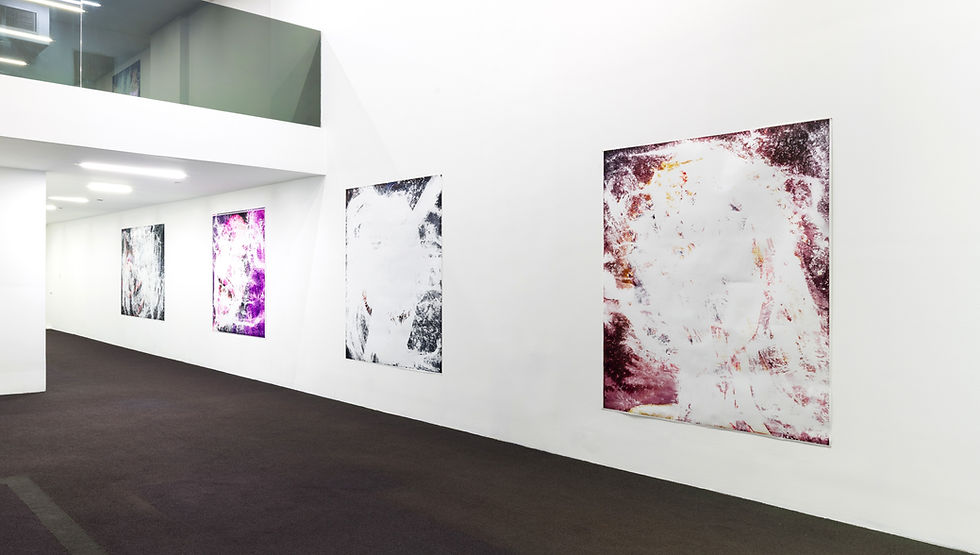
Installation View, 2026, courtesy of Alex Berns, photo by Carter Seddon
And so it is that we moved from modern naïve kitsch to postmodern cynical camp, from the modern figure of the clown as subversive disruptor of social codes, to postmodern clichés of the art world as circus, of terror as a joke, of the clown as cynical insider of the joke being played on us viewers; in which case the main ideological subtext would be that subversion ends up being a terrifying proposition, and as such, not necessarily a very healthy political position to consider.
In our times of pervasive narcissism and of selfies mass hysteria phenomenon, it is the very undecidability of this question, the unresolved paradox of the clown’s identity which grants it a singular pathos. And it is our empathy for the pathetic which confers it its camp quality.
If these pieces seem to mix postmodern notions of spectacle, simulacrum and of the performative, contrary to the cool, ironic, analytical, postmodern strategies, they also offer a hot, subjectively involved approach to their subject matter which obliquely seems to hark back to Antonin Artaud’s “Theater of Cruelty” (where “cruelty” was originally meant as existential pain) and to his ideas about violence as catharsis. Rather than addressing a new version of the quarrel between the post-moderns and the moderns, the show may have put a proverbial finger on one of the sore points, not just of our culture’s relationship with camp, but more importantly, of how much, just like our social contract, our cultural contract needs to be constantly reassessed and renegotiated.
And then, if we are to follow the clues from the pun in the show’s title, perhaps what is being addressed here is the immaturity (as Witold Gombrowicz would call it) of a Rauschenberg’s erasing of a de Kooning drawing, the naïve oedipal gesture of cancelling the previous generation’s achievement as a pre-condition for new ambitions, not just the inescapable symbolic killing of the father, but in the same instance, the creation of a precedent which, in turn, sets the stage for the future erasing of Rauschenberg himself by the next generation. A familiar story, the moral of which may very well be, this time: In art, be careful what you are wishing for.
In a 2023 group exhibition in the East Village, Mitchell presented a piece titled “To Shoot a Gun”, which consisted of an actual shotgun riddled with bullet holes hanging on the wall: a visual summary of the effects and consequences of actions onto themselves, an image of violence bouncing back to its own source, boomeranging back onto itself. That piece summed up quite concisely a major concern of his work so far: The circulation of the symbolic violence at different levels in our culture (kitsch-camp being one of them) as self-destructive mimetic mechanism and its ultimate folding back onto itself, which, clearly, also informs the present show.
So, how should we call this circular movement, this closed loop, the circularity of a self-critical American modernist/postmodernist cycle endlessly coming back to haunt us, even now in this meta-modernism moment, as self-repeating and self-destructive impulse? Call it the Boomerang effect?