

B³
Ilana Yacine Harris-Babou and Patrick Carlin Mohundro
Essex Flowers Gallery, 19 Monroe Street
September 12 - October 11, 2026
By Ian Cofre, October 9, 2026
The two-person exhibition B³ at Essex Flowers Gallery, featuring individual and collaborative works by Ilana Yacine Harris-Babou and Patrick Carlin Mohundro, tackles the topic of alienation caused by the ubiquity of smartphones, re-examining our dependencies and displaced desires through a series of material propositions. In their first exhibition together, the artists ask us to consider the many ways we casually touch our devices—the taps, swipes, presses, and pinches—substituting different mediums for the glass screen that usually absorbs our attention to make visible and reinterpret the traces of wasted time.
In the front room gallery, the initial encounter is with three distinct, sequenced works arranged in a minimalist installation. To the left, Harris-Babou exhibits small hazards and Swipes with Friends (both 2026), aluminum-framed tiles of concrete embedded with glazed ceramic finger and thumb prints in a frieze-like arrangement. Created in concert with friends and family in a social atmosphere, each small protrusion is a unique, miniature sculpture that records a different gesture and pressure applied to the clay. The accumulated taps swallow up those in-person exchanges and affective labor into what looks like a mass of chewing gum or empty seashells overtaking a sidewalk, or a zoomed-in look at the pixels that make up a picture on a screen, far beyond intelligibility.
Connecting the gallery’s floor-to-ceiling span in quick succession, two thin strips of glass tiles soldered together, one transparent and colorless, the other made from a rainbow of stained glass, make up Mohundro’s Vertical Construction with Mirror and Glass and Stacked Color (both 2026). They are meant to evoke the individual, solitary touch of an endless doomscroll, but they are also like separated strands of DNA, unzipped and unwound, prepped for a different kind of sequencing.

Patrick Carlin Mohundro, Perspiration Conspiracy, 2026, Cast Deodorant, Dimensions vary, Photo: Garrett Carroll. Courtesy of the Essex Flowers Gallery, NY.
The final work to the right is titled Perspiration Conspiracy (2026), sculptures of the iPhone 4 form factor are cast from Speed Stick deodorant and arranged into two sets of seven. The objects will lose moisture and curl into desiccated husks over the length of the exhibition, staining the wall with faint green drips.
Together, these works disorient the senses: an unmistakable fragrance overwhelms the space to nauseating effect, your perspective shifts back and forth from micro to macro views and between the x- and y-axes. It all hits like that flicker of recognition that you should be paying more attention when crossing the street with your head down engrossed in a screen, the bare minimum of a reaction for self-preservation. It's all around you, it's changing the way you think and feel, even your DNA. Consider this a wakeup call.
How we socialize had already changed fundamentally and was changing further well before the COVID-19 pandemic, in no small part due to the advent of powerful smartphones and all their attendant capacity and applications designed for maximum diversion. That is, diversion in the sense of delivering entertainment and distraction, as well as diverting us from social and physical interactions, manifested as a deluge of the former, and a narrowing of the latter. Surveillance and advertising technologies collapsed into an apparatus capable of turning our data into a steady stream of self-satisfying serotonin bumps. The promise of global and unlimited connectivity reversed course from any lingering utopic dreams of growing a united, collective network, instead trapping and atomizing attention into a one-sided conversation with a glowing prosthetic.
These concerns and others appear in Mohundro’s newsprint manifesto, also titled Perspiration Conspiracy, that accompanies the exhibit, printed and cut to mimic an iPhone manual. In it, he references Byung-Chul Han’s Non-Things: Upheaval in the Lifeworld where the philosopher describes the smartphone as an Autistic Object. Beyond the psychoanalytic interpretation of its qualities, that is, of being a self-referential, narcissistic, mirror object, it has become evident that our devices maximize anxiety, repetitive actions, and an aversion to other social interactions, quite literally replicating autistic behaviors for profit.
If we could pull ourselves away long enough from our attachments, we might contemplate how far the device's capture has infiltrated different spheres of our lives and dulled an awareness of the body, and just how much further we have to go to recover from it.
A shallow self, a shadow self, and a shallow shelf
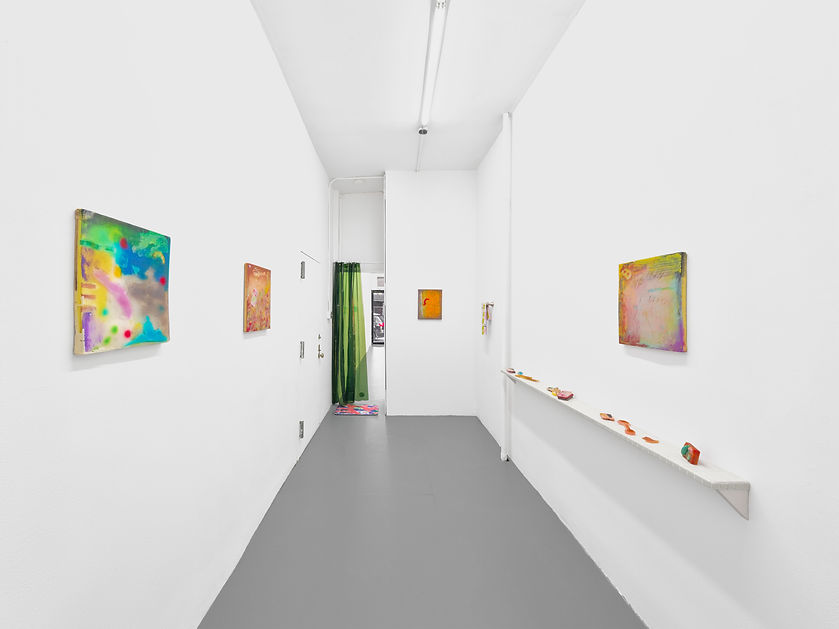
Ilana Yacine Harris-Babou + Patrick Carlin Mohundro: B³ Installation view. Photo: Garrett Carroll. Courtesy of Essex Flowers Gallery, NY.
A green shower curtain subdivides the gallery, a subtle indicator that you have transitioned through spaces of affect. The polite display of the first installation gives way to the much more maximalist and embodied propositions secreted in the back room. This is where the conceptual premise of Bed, Bath and Beyond Abstraction and the overlapping concerns of Breath, Body, and Beauty (hence the title B³) that both artists have adopted are experimented with fully. That final frontier of the public/private divide, the bathroom, is up for grabs, and the artists have chosen excretion over extraction. Here, the artists' misuse the very same tools of distraction to create a different class of art object, in several denatured and messy iterations, that they encourage visitors to directly engage and touch. Upon entering, you are welcomed by a bath mat printed with a screenshot altered by the markup app, a soft screen stand-in that you can vigorously wipe your feet on (several variations are available as a low-cost takeaway).
A similarly printed hand towel bearing the trace of the word “attachments" shares a wall with a tableau consisting of a narrow, white-tiled shelf occupied by a cast comb, razor, corn cobs, peach pit, and iPhone-shaped soaps, under a painting with a fogged-up Richter quality, situated like a mutant vanity. In fact, each of the four collaborative cast soap paintings is backed with a mirror, in which the faintest shadow follows an onlooker’s inspection of the works that appear to sweat, slick and tacky to the touch. One painting in particular, Effluvium Kernel (2026), incorporates some of the identifiable objects from the shelf floating over a gauzy mound of colorful flecks, a carnivalesque trash pile as the final resting place for these odds and ends.
Harris-Babou’s and Mohundro’s concern with the immediacy and intimacy of touch makes the exhibition an investigation and reassessment, however distant it might feel, of post-pandemic haptics. They reject the antiseptic, technological trap of increasing virtuality, replacing it with something concrete, oozing, sticky, and sensuous. In the front room, the artists have abstracted the touch, revealing it through repetition and absorbing that fragmentation into contemporary mosaic sculptures. In the back room, they invite the touch to co-create a cumulative self-destruction of the colorful elegy of objects made from recast soap and Speed Stick, bath mat and towel prints, and tiled shelf of fake toiletries. The works conspire and perspire to create a synaesthetic experience, both seductive and repulsive, of cast-offs that aim to take us out of the narcissistic doom spiral, even if some learned behaviors remain.