

Aaron Michael Skolnick, Liza Performing in Cabaret (series), 2026. Courtesy of Kravets Wehby Gallery
How To Escape a Whirlpool and The Logic of Fixation
Kravets Wehby Gallery, New York
by Mer Mora, July 11, 2026
How To Escape a Whirlpool, co-curated by Emily Saltman and Hannah Studnick at Kravets Wehby Gallery, frames obsession as both a source of creativity and a force that can consume us. Inside the small Chelsea space, the featured artists—Noel W. Anderson, Claudia Bitrán, Laura Collins, Jackson Daughety, Anna Pederson, Katherine Sepúlveda, Aaron Michael Skolnick, and Orli Swergold—share a single starting point: fixation. Across painting, beadwork, and mixed media, each returns to a chosen figure or symbol, depicting it over and over. The closer you look, the more you find yourself doing what they do: circling the same face, the same gesture, and the same symbols. As you continue going back over and over to look deeper, the show quietly implicates you in the same cycle it sets out to examine.
Walking into the space, Britney Spears' face is immediately recognizable among the works. Claudia Bitrán’s portraits depict two different moments of the singer’s life. In Britney Portrait 7 (2021) Bitrán portrays a younger Britney sometime in the early 2000s. The brushwork is smooth, giving the painting a delicate clarity that allows us to see every detail of her expression, looking not directly at the viewer but past them. Across from it, Britney Portrait 14 (2021) portrays the infamous 2007 “meltdown.” Her head is mid-shaved and one of her eyes is bright red as she stares directly at the viewer. Despite being the same medium as the previous work—oil on canvas—the brushwork is restless and uneven, creating an instability that contrasts with the softness of the first portrait. Together, the works are an intimate record of Bitrán’s devotion to the singer. We watch Bitrán watch Britney—images shaped by years of looking and the history that comes with it.

How To Escape A Whirlpool, 2026, installation view. Courtesy of Kravets Wehby Gallery
Continuing with celebrities, Laura Collins and Jackson Daughety turn to figures whose entire existences are shaped by being watched publicly. Drawing from reality TV and influencer culture—forms of entertainment built on the promise of unfiltered access—they depict people who have willingly turned their lives into something to be consumed. Collins’s paintings present three Real Housewives—Porsha Williams, Dorinda Medley, and Tamra Judge—each caught mid-action, speaking and pointing. While Dorinda is pointing to herself, Porsha and Tamra point to someone outside of the frame, and standing in front of them, we become the ones singled out. In contrast, Jackson Daughety's MrBeast Super Bowl Halftime Show (2025) leaves its subject out entirely. The YouTuber is nowhere in sight; Daughety paints the crowd instead. Bodies and flags blur into a spectacle of collective attention, with thousands of people performing their obsession for a figure we can't see. In both works, the image matters less than the attention around it. Obsession no longer depends on intimacy or even proximity; it depends on the constant circulation of images that keeps viewers looking.
Noel W. Anderson narrows down the spectacle to a single individual. Fan-Addict 5 (2023) depicts a cheering figure in motion with his hands raised and his head duplicated as he seems to be jumping up and down. Across the surface there are scraps of an eye, lips, and numbers fragmenting. Where Daughety's crowd performs its obsession collectively; Anderson shows what it costs the obsessive: the looker coming apart under the force of his own looking. The crowd has disappeared, leaving only the fan and the image that has begun to overtake him.
Aaron Michael Skolnick and Katherine Sepúlveda turn that same compulsive attention inwards. In the series Liza Performing in Cabaret (2026), Skolnick stages a slow synthesis through the three works. Starting with Liza Minnelli’s portrait, as we move through each piece, his own face begins to emerge through the layers of oil on linen. First one eye, then two, then the shape of his beard. Despite not seeing Skolnick fully merge into Minnelli, the full morphing feels inevitable. Skolnick lets Liza dissolve into his own image; Minnelli’s identity is blurred, as if the sustained looking has begun to erode the distance between the two.
Where Skolnick dissolves into his object of devotion, Sepúlveda builds a shrine around hers. In Soft Girls (2025), nude bodies, intimate objects, crosses, and references to television shows and books—elements of her life and mind—are jammed into a neon landscape. It’s not a portrait of any one fixation but the sum of them, her own interiority turned inside out. The person at the center is the one thing she never depicts; we read her through the pile she's assembled around herself.
How To Escape a Whirlpool never answers its own question, and I don't think it ever intended to. The artists are trapped in a loop; you see it in the repetition of Orli Swergold's spiral-like figures or the hundreds of glass beads Anna Pederson threads into Horse Gates (2026). The show puts you in that position too—Britney stares at you mid-breakdown, and Collins's housewives point you out. Daughety folds you into his crowd—you don't escape the whirlpool.
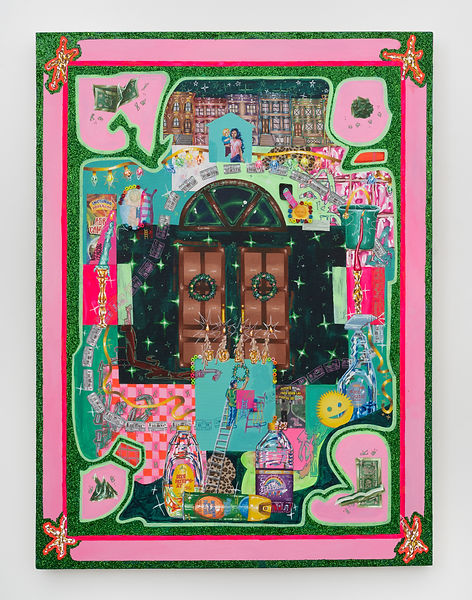

Katherine Sepúlveda, Service Entrance, 2026. Oil, acrylic, glitter, magazine clippings, and spray paint on canvas, 48 x 36 in. Courtesy of Kravets Wehby Gallery
Claudia Bitrán, Britney Portrait 7, 2021. Oil on canvas, 17 x 14 in. Courtesy of Kravets Wehby Gallery