
HOWARD R. CARR
STILLNESS IN ACTION AND THE LONG CONTINUITY OF PRACTICE
By Ce Jamieson, September 21, 2026
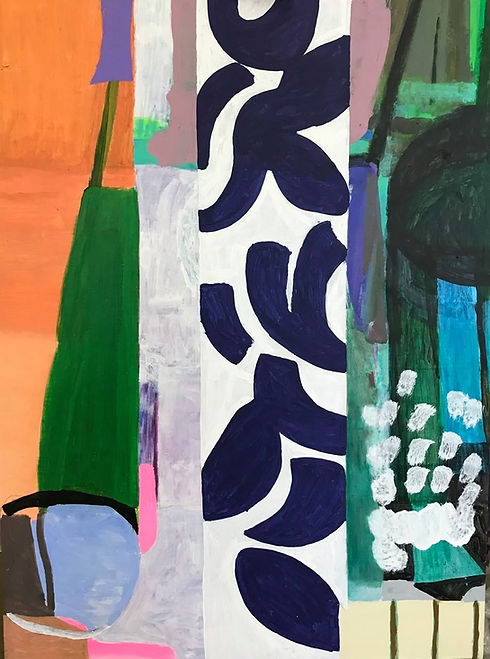
Image: Howard R. Carr, Untitled. Acrylic on canvas, 36 × 48 in. Artwork copyright © Howard R. Carr. Courtesy of the artist.
“Stillness in action / Free and clear of clamor.”
The words belong to Washington, D.C. artist Howard R. Carr, and they offer an unusually precise way into a career that has never been
particularly interested in staying in one place. Across more than five decades, Carr has moved between painting, sculpture, assemblage, unconventional materials, recognizable images and abstraction. At first glance, the resulting body of work can seem almost too varied to belong to one artist. Look longer, however, and another kind of continuity begins to emerge: not a repeated style, but a repeated willingness to begin again.
Carr’s history also passes through some unusually vivid corners of twentieth-century art.
Govinda Gallery founder Chris Murray has written that Carr met Salvador Dalí in Cadaqués in 1971. The following year, Carr returned to Spain with Murray and artist Kim Waters. Murray recalls that the three spent roughly six weeks playing music during evenings at Dalí’s home in Port Lligat.
More than a decade later, a 1984 photograph preserved by Photo Museum Ireland places Carr at Govinda Gallery alongside Andy Warhol, Peter Wise and Martin Kotler, with Murray in front.
These are irresistible names in any artist’s biography. They are also, I think, the wrong place to stop.
Carr did not build his artistic identity around proximity to Dalí or Warhol. The documented record repeatedly returns instead to the studio, to exhibitions, and to the movement from one kind of object or image to another.
That distinction matters.
The art world is exceptionally good at preserving mythology. Certain names become landmarks, and everyone who passed near them can become a footnote to somebody else’s story. Carr’s career offers a different question: what happens when an artist passes through those
environments and simply continues making work?
By February 1977, Carr was making Big Fry, an installation of enormous fried-egg forms placed on the frozen Potomac River. An archival
photograph shows the absurdly domestic image transformed by scale and location, sitting on the ice with Washington in the distance.
The following year, Howard Carr, Paintings opened at Govinda Gallery. He returned to Govinda in 1984, when The Washington Post considered his oils. The paintings described there belonged to a world of gardens, food, figures and domestic pleasures, with affinities to
European modernism.
Fourteen years later, the picture had changed.
Reviewing Carr’s 1998 Govinda exhibition, The Washington Post encountered paintings, sculpture and assemblage and described an
artist working with an unusually broad range of skills. One of the central works was Perspectival Study of a Chalice, an elaborate
construction inspired by the Renaissance artist Paolo Uccello’s investigations of perspective.
The distance between those exhibitions is telling. Carr had not spent fourteen years refining one recognizable product. The materials
changed. The visual language changed. The questions changed. That restlessness remains visible in much more recent work.
Consider six paintings made between 2019 and 2021.
In Slug 2, a small creature gives scale to a looping pink line that stretches across the canvas. The slug is recognizable, but the line
quickly asserts an independent life of its own.
Blue Palm works in the opposite direction. A branching blue gesture almost becomes a plant—or perhaps a plant becomes a gesture.
Blue Sparrow, only four by six inches, places a bird beside a harmonica with an intimacy that feels nearly anecdotal.
Elsewhere, recognition becomes less stable. A pale emblem in Ferro da Gondola is absorbed into a structure of blue, yellow, pink, dark marks
and repeated forms. In M, a black angular shape and a wide pink diagonal organize a field of layered color. An Untitled 2019 canvas
uses dark curved forms, orange, green and a pale central passage to create a composition that seems to hover between structure and
improvisation.
What connects these pictures is not a single subject. It is the act of seeing something become something else. Carr’s own earlier correspondence offers glimpses of that process.
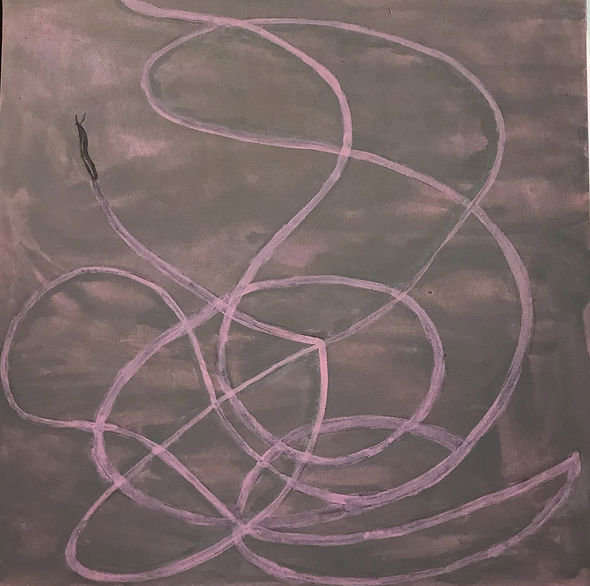
Howard R. Carr, Slug 2. Latex on canvas, 40 × 40 in. Artwork copyright © Howard R. Carr. Courtesy of the artist.
Writing about a recent landscape, Every Vista a Gainsborough, he described watching the image emerge from a surface that had originally
served as his palette: “It was fun for me to see it reveal itself from being the palette I was using.”
That sentence may explain more about the continuity of his practice than a conventional stylistic label could.
The picture was not fully imposed upon the surface. It was discovered in it. Other works begin with very different kinds of material.
Carr has connected Frog Jumps In and Old Pond to Bashō’s poetry. He has described Blue Guitar through memories of Picasso and John Singer Sargent. A work inspired by India developed from the architecture and color of Jaipur, while another painted form became, in his
description, an elephant’s trunk seen simultaneously from different directions.
Language itself can become visual material. In Je ne Comprends pas Verlan, Carr transformed maps and French linguistic references into
painted forms. A Paris Metro map becomes associated with the profile of a rooster; the shape of France becomes a fleur-de-lis; profiles appear to speak across the meeting point of two canvases.
In Riddle Me This, geometry meets mythology through Carr’s association of a fluorescent form with the Sphinx and the riddle of Oedipus. These explanations do not produce a neat system. That is their value.
A poem, a journey, a map, a palette covered in leftover paint, an art-historical image, a linguistic joke or a remembered shape can all become starting points.
The materials are equally unwilling to behave consistently. Across the broader body of work Carr has used canvas, foamcore, Mylar, Plexiglas, construction paper and found or unconventional materials. Painting exists beside sculpture and assemblage rather than above them. The temptation when looking at a long artistic career is to search for an orderly progression: early work leading to mature work, experiments
resolving into a signature, uncertainty eventually becoming certainty. Carr’s work resists that story.
The stronger continuity may be curiosity itself.
His history touches Dalí, Warhol and a Washington art world that changed dramatically around him. It includes exhibitions separated by decades and work that refuses to settle permanently into one visual identity. Yet the central activity remains remarkably ordinary: returning to the studio, looking, altering, discovering, beginning another work.
Perhaps this is what “stillness in action” ultimately describes. Not stillness as repetition.
Not stillness as retreat.
But the quiet persistence of remaining available to the next idea. In an email this summer, Carr described his present position with characteristic economy: “The creative adventure continues.”
After more than fifty years, it does.
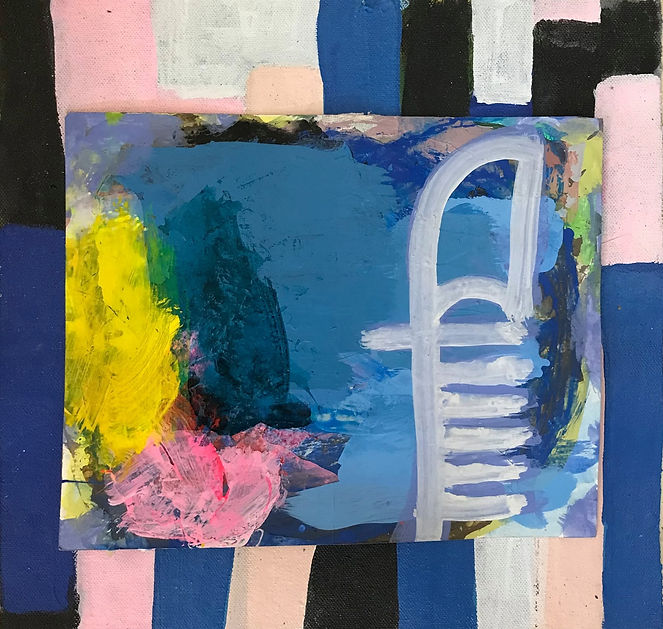
Howard R. Carr, Ferro da Gondola. Acrylic on canvas, 12 × 12 in. Artwork copyright © Howard R. Carr. Courtesy of the artist.