

The Turbulent World of Jessica Nissen
By Carl Watson, January 12, 2026
“Gilded Froth” Pastel on Paper, 25.5” x 19.5” 2020
I don’t remember where I first saw Jessica Nissen’s paintings. It may have been at the Coral Door gallery in the West Village, but I’m pretty sure I had seen them earlier, if only on social media. Her work struck a chord immediately, not just for its vibrant color and turbulent energy, but it also reminded me of certain Romantic landscape painters of the 19th Century, such as J.M.W. Turner, Caspar David Friedrich, or Thomas Cole.
Nissen might well be thought of as a conceptual landscape painter, but I doubt anyone would consider her a Romantic artist. Still, there is a thread here worth exploring. I need to mention that Jessica Nissen does not have just one mode or style of painting. A visit to her website will present a number of thematic series, but I will be concentrating only on two of these in this essay, those that best illustrate my reactions and appreciation. The paintings I will discuss come from the two series called “Froth” and “Mind Storms and Echoes.”
The first of her paintings that I was exposed to were those from the “Froth” series. These canvases are striking, both for their startling brightness and for the turbulence they depict via a palate of brilliant oranges, yellows, greens, grays, pinks and magentas. Various natural and unnatural phenomenon come to mind such as volcanic flows of magma, fiery clouds of explosive gas (think of exploding vehicles in action movies, or burning oil wells), thermonuclear explosions or the gaseous nebulae in which stars are born, such as we see through the James Webb telescope.

“Froth Emanation” Oil on Panel, 40” x 40” 2024

“Perpetual Landscape” Oil on Panel, 60” x 48”. 2021
However, there is more here than the simple depiction of nature-made violence. Nissen is well aware of the physical theories that inform her work. Concerning the “Froth” paintings, she cites the mathematician Karen Uhlenbeck and her discovery of a phenomenon called ‘bubbling’: "A bubble is the physical world’s solution for a mathematical challenge: to minimize a surface area — in this case, one that surrounds a prescribed volume of air. Nature is always seeking to optimize, to maximize gain at minimal cost.” In the “Froth” paintings Nissen is “extrapolating this mathematical theory to apply to both a physical structural reality and a metaphysical phenomenon . . . as both a life-giving force of nature, and a destructive event caused by climate change or natural disaster.” To that end she presents “a perpetually changing landscape it is our challenge to navigate.”
I want to dwell here on the idea of “perpetual change” and draw attention to the paintings’ ability to confuse or transcend fixed categories of states of matter. The initial reaction of the viewer might be to pin down what they are looking at. But, to my mind, these paintings do not depict just one state of matter. What I mean is that, the longer we look, the less sure we are as to what we are looking at, and this is due to the phase changes suggested in the presentation. One corner may appear gaseous, another liquid, while another part of the painting might seem to be a solid—and, our perception of each region can change before our eyes. I suggest we are seeing a presentation of a primordial ‘condition of becoming,’ combined with its opposite, dissolution.
The artist describes the “Froth” series as emphasizing “the fragility of the underlying structures of reality.” To this end, she has suggested a relationship between the bubbling Froth and the concept of Quantum Foam—a theoretical concept describing the foamy structure of space/time—a chaotic ever changing landscape of tiny regions where virtual particles constantly pop in and out of existence. This ‘foam’ is the substructure of the physical (and mental) world— our bodies, our brains, everything we are aware of, and of which we ourselves are but temporary structures.
The question of scale also comes into play, as the instability that defines quantum foam can be applied to everything from the micro and macro, from the subatomic to the geological to the astrological, and even the psychological. Nissen writes that "Froth" is also a metaphor for the constant flux and churn of our collective psychology and emotional ties to each other.”
I am reminded of Buddhist notions of insubstantiality and impermanence, which suggest there are no ‘things,’ there are only events, events that happen so rapidly they may seem to present a stable object to the senses, but this is only due to our conditioning. In other words, we are taught (conditioned) to see the continuity of being (stable form) as a quality of the object. But our perception of the object is really a perception of a series of events, arising and passing away almost instantaneously. Our thoughts are also events, arising and dissipating in a moment. Nothing has its own existence but is dependent on constant flux. In Nissen’s “Froth” paintings every state of matter seems on the verge of change—liquid becomes gas becomes solid which liquifies. Images like Gilded Froth, or Verdant Froth, present something closer to a solid state— quantum foam as a kind of fossilized chaos, resembling igneous or other conglomerate rock formations. But look again and it changes.
In addition to changes of state, there are other fluid qualities we might notice. Paintings like Surge and Cherry Bomb Nebula might trigger a sensory memory due to their saccharine quality, like that of hard candy melting under the eye of a subconscious desire, adding yet another state to the turbulent mix, one that has more to do with memory, sensation, emotional valence, and yes, even the destructive quality of pleasure. We see this confluence of the saccharine and the deadly in paintings like Atomic Froth, Eruption, and Saccharose Annihilation, all of which depict mushroom cloud-like formations that also resemble confections. Nissen’s interest in the aesthetic sweet tooth is further explored in a whole series of candy-themed paintings, “Cosmic and Candy Grotto,” which are more literal in their representation.

“Saccharose Annihilation” 21” x 21” 2019
Students of fluid dynamics are familiar with the idea that turbulence in a system, which may seem merely chaotic, is also a form of order. Vortices and waves, crests and rolls, are the ways that fluid or gaseous matter self-organizes to accommodate incompatible pressures. Seen this way, tornadoes and hurricanes are actually forms of self-organization arising from conflicting zones of atmospheric pressure and temperature.
This brings me to the second series of paintings I’d like to discuss: “Mind Storms and Echoes,” which depict a self-contained area of turbulence, a storm of sorts, suspended in the air, in contrast to a static, calm background. Unlike the “Froth” paintings which place the viewer in the midst of the turmoil and disorder, these paintings put the viewer at a distance. We seem to be positioned on an empty plain confronted with a kind of condensed electrical storm, a single cell of violent erratic energy by which we are attracted, fascinated and drawn into contemplation.
For lack of a better word, I call these formation storm cells, which can represent thought processes in our brains. Due to their agitation, these processes register as anxiety, although even pleasure might appear as agitation when rendered in the form of electrical impulses. But they also have an ephemeral quality, a fairy-like beauty that dampens the threatening aspect. The storm cells cast black shadows on the ground, which the artist relates to a mirror’s reflection. Nissen calls the paintings in the “Mind Storm” series, impressions “of the various states of mind or psychogenic energy and their shadows or false reflections…that are in dialogue with them… as though the image is talking to itself.” One might read this as a description of consciousness— the inner dialogue between process and its reflection. We can also make the association with the theory of Plato’s Cave, in which the reality we see is only the shadow of a more complete reality beyond our senses.
The backdrop in these landscapes remind me a little of the monotone un-delineated backgrounds of a Yves Tanguy or Salvador Dali painting, or other surrealist landscape. There is no foreground, no horizon, no defining line between ground and sky, which are instead merged into a simple gradation of a solid color. It is a landscape of the imagination that is unearthly, celestial and psychological all at once. They are closer to the surreal than to the expressionistic or representational.
What interests me in this series is the connection between meteorological, thermodynamic, and psychological turbulence. Like the “Froth” paintings, these “Mind Storms” are examples of how beauty can also invite the contemplation of death. Beauty can kill and these paintings attract by an energy that hypnotizes, in part, by its relation to danger, death, dissolution. By example, I recall the brightness of the “Froth” paintings—a brilliant light suggesting an extreme heat in which consciousness cannot exist. It is an annihilating landscape that, in the form of art, allows us to imagine the danger of our own destruction.
This relation to danger brings me back to my original associations. I mentioned at the beginning that Nissen is not a typical landscape painter and could not be considered a Romantic and yet my first thought in analyzing the effect of her work was through the theoretical framework of the Romantic Sublime. Admittedly, as mentioned earlier, this is not the direction most people would take, but for me it’s a way to contextualize the effect these paintings have. Briefly stated, the sublime is an aesthetic of transcendence based in the viewer’s confrontation with overwhelming power and the vastness of nature.
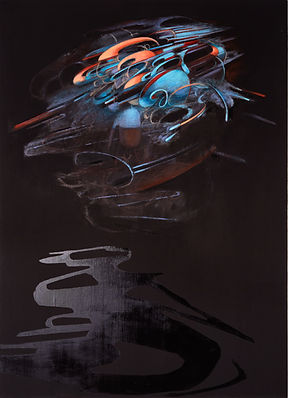

“Red Storm” Oil on Panel, 32” x 44” 2013
“Blue Storm” Oil on Panel, 32” x 44” 2013

“Green Storm” Oil on Panel, 32” x 44” 2013
There are many aspects to the psychology of the sublime and various ways it can manifest in art. Looking at my own bookshelf, I see titles such as The American Technological Sublime, The Egotistical Sublime, The Impersonal Sublime, The Urban Sublime, The Romantic Sublime, Solitude and the Sublime, Romantic Turbulence, The Analytic of the Sublime, etc. Each title addresses the aesthetic of sublimity in relation to particular literary, artistic, architectural and media contexts.
My own investigations began with Emmanuel Kant and Edmund Burke, both of whom addressed the Sublime as being in contrast to the Beautiful and the Pastoral. Concerning the mathematical sublime, Kant writes: “The beautiful in nature is a question of the form of the object, and this consists in limitation, whereas the sublime is to be found in an object even devoid of form, so far as it immediately involves, or else by its presence provokes, a representation of limitlessness.” He makes a distinction between the mathematical sublime which affects our imagination by its vastness, it’s magnitude and its progress toward the infinite, and the dynamic sublime which affects us by its power, its turbulence and its potential to instill terror. Of course, both of these can be present in a single image.
Thomas Weiskel calls the sublime a psychology of transcendence, which comes about by presenting a situation in which the vastness or violence of space, and the feeling of being overwhelmed by the power of nature, (or in some cases human creation) causes a feeling of both vulnerability and excitement. The viewer is placed in a situation where they can imagine the fear and terror of losing the borders of the Self to the contemplation of overwhelming force. It is this imagined loss of self-definition that can lead to a feeling of transcendence. In is important to point out that the viewer is put into the position of imagining this threat, without actually being threatened. The sublime is defined by the movement of the mind it affects.
In Nissen’s paintings, we are asked to contemplate the conflict between humanity and the environment, between human emotion and the indifferent universe to which we bear witness. One might ask where is the point of view, where is the location of the seer? In Nissen’s paintings, there is no human figure to provide scale. Often in pictorial representation of the sublime, especially in Romantic painting like Turner, there is often some representation of humanity, a castle, a boat, a cottage, or some human figure with which we can identify, and into which we can project ourselves and thus imagined the threat as real. This is also true in some scenes in the series “The Voyage of Life” by Thomas Cole, or certain the paintings by Caspar David Friedrich, especially the anonymous tiny figures in The Monk by the Sea or the Chalk Cliffs on Rugën. These paintings are examples of the Romantic sublime in which the human figure is dwarfed by nature.
I would point out here that the sublime in landscape painting is generally associated with a perspective of distance that augments the feeling of vastness and infinitude. However, Nissen’s “Froth” paintings, while generating a similar effect, bring us much closer. We are in the midst of that which might inspire our terror. We are the unmediated witnesses to the elemental energy, the fire of creation, the darkness of destruction. The viewer is at the edge of the volcano, hovering just above the surface of the sun, inside the nebula, inside the atomic explosion, inside the ferment of elemental creation, and along with that there is a sense of longing or at least relief— to be lost in the turbulence and therefore lose whatever boundaries of ego that entrap us. Simple beauty alone cannot deliver us. Beauty wants to rest in the stasis of an ideal. The sublime on the other hand wants us to taste transcendence.
As a punctuation point to the act of witness, we have the Nissen eyes. After each painting is finished, she uses the leftover paint to make an eye, which has the colors of the particular landscape she has finished painting. It is as if, once the painting is complete, an eye is fashioned from the stuff of its creation, making an additional painting that is able to look back upon the landscape of its own creation, and so the eyes are connected to the painting they come from.
By way of conclusion, I would add that, for me, the encounter with art has the most value inasmuch as it disturbs our complacent framing of reality, presenting a challenge to habitual conceptions that helps to free imagination and intellect alike. By that measure, the most effective art embodies a question that elicits an expansive desire for further exploration. We are asked to read, to interpret and to reread, and more importantly, to feel, and perhaps to explore what and why we do feel. Jessica Nissen is more than just a painter of striking canvases, her works are grounded in scientific, metaphysical and psychological theories that keep the mind working, wondering, and exploring the mysteries of our reality.
***
References
Edmund Burke, A philosophical Enquiry into the Origin of Our Ideas of the Sublime and Beautiful
Immanuel Kant, The Critique of Judgement
Karen Uhlenbeck “In Bubbles, She Sees a Mathematical Universe” April 9, 2019, The New York Times
Thomas Weiskel, The Romantic Sublime: Studies in the Structure and Psychology of Transcendence
Carl Watson is the author of four novels: Only Descend, Idylls of Complicity, Backwards the Drowned Go Dreaming and The Hotel of Irrevocable Acts. He has also written several books of poetry, including, After Thought, Stage Fright, Pareidolia and Astral Botanica.
Jessica Nissen is a native New Yorker. Nissen's studio is in Sunset Park, Brooklyn.

“Tiny Eyes in Progress”Oil on Wood 2025