

The Myth and Resilience of Leonora Carrington
L'SPACE, New York
by Laura Horne, July 11, 2026
Installation view of Ship of Cranes, 2010, Lost-wax bronze casting, 48 x 79 x 33 in, 122 x 201 x 83 cm, Edition: 8/12 + 2A/P
Provenance: Leonora Carrington Council
There is a distinct, inescapable gravity to the surrealist legacy of Leonora Carrington (1917–2011). Decades after she retreated into the mystical landscapes of Mexico, the British-born artist is exerting a magnetic pull over New York City. “Shape of Dreams” currently on view at L'SPACE Gallery in Chelsea, opens up Carrington’s universe as an active, urgent blueprint for modern creation and psychological survival. Featuring monumental sculptures that were finalized around 2011, right before Leonora passed away at age 94, they feel thousands of years old, as if they were dug up from an archaeological site rather than cast in the 21st century. By 2011, Carrington was battling severe arthritis and failing vision, requiring assistance to realize these massive scales.
Lili Almog, the director of L'SPACE, approaches curation as an artist not necessarily as an art dealer. Almog’s own latest body of work focuses deeply on women, religion, and the politics of visibility, specifically a series of shrouded female figures placed in settings where art history traditionally demands the passive female nude. Almog saw Carrington’s work for the first time during Zona MACO, an art fair in Mexico City in the early months of 2025. A selection of Carrington's tapestries, puppets, and tarot cards, Almog immediately recognized them as rare artifacts and sparked the idea for this exhibition.
At L'SPACE, Almog arranged Carrington’s sculptures to feel like a mystical, private garden emanating spaces found in Mexico for visitors to wind through. Though the works are priced between $150,000 and $800,000 and are in editions of six or twelve, their commercial value fades behind their visceral, ancient presence. The exhibition is a collaboration with Consigna Gallery, Mexico City with the support of the Leonora Carrington Council.
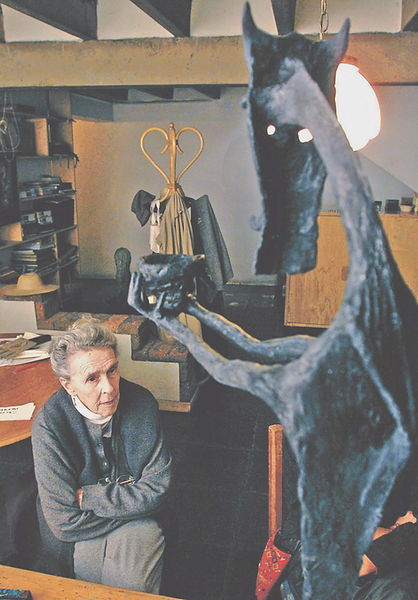
Leonora Carrington with her sculpture “La Virgen de la Cueva” (2000)
The exhibition features seventeen sculptures by Leonora. Seventeen was her favorite numeral, carrying immense spiritual weight for an artist who spent her life immersed in the occult. In Tarot seventeen is the number of “The Star” , the card of hope, divine guidance, and psychological survival after a great trauma. In numerology, the digits of 17 reduce to 8 (1 + 7 = 8), the symbol of infinity representing cosmic balance and the bridge between the material and spiritual worlds.
The seeds of Carrington's sculptural practice were planted in the 1930s in France, where she worked in plaster with Max Ernst. However, it wasn't until the 1950s in Mexico that she truly began developing these specific forms on a small scale out of wood or ceramic. Leonora kept them as talismans, sacred items charged with private meaning which she kept tucked away in her home. Decades later, in the early 1990s, Carrington began translating these intimate figures into large-scale bronze sculptures, some of which were installed in the streets of Mexico City in 2008.*
Carrington’s trajectory was defined by an unyielding defiance of boundaries. Born into an upper-class family in Lancashire, England, she fiercely rebelled against her strict Roman Catholic upbringing and the suffocating expectations of debutante balls. Her imagination was instead fed by Irish fables, fantasy literature, and the works of Lewis Carroll, cultivating a youthful mindset that she carried into her final days.Though she established a home in France with lover Max Ernst and integrated into Paris’s inner Surrealist circle at age 20, she resisted being boxed in. At a time when the male founders of Surrealism sought to relegate women to the role of a passive “femme enfant” or mystical muse, Carrington pushed back: “I didn’t have time to be anyone’s muse,” she noted. “I was too busy rebelling against my family and learning to be an artist.” **
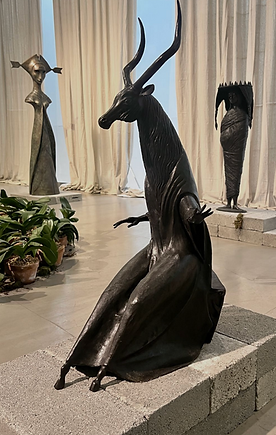
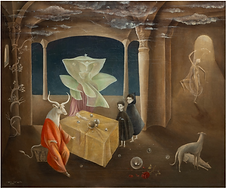
The Daughter of the Minotaur (La Hija del Minotauro), 2010, Lost-wax bronze casting, 32 × 15 × 22 in, 82 x 38 x 55 cm, Edition: T/P 1/2 (Edition of 6 + 2 A/P), Provenance: Leonora Carrington Council paired with And Then We Saw the Daughter of the Minotaur, 1953 (Collection of MoMA, New York)
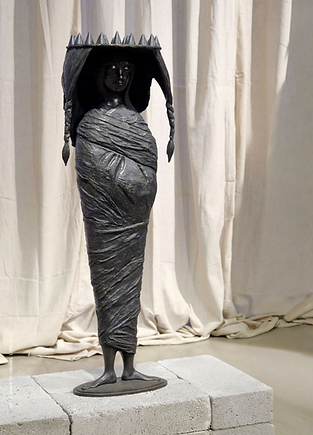
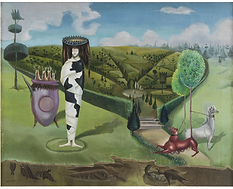
Oval Lady (Dama Oval), 2010, Lost-wax bronze casting, 38 x 13 x 10 in, 97 x 33 x 25 cm, Edition: 3/6 + 2 A/P + T/P, Provenance: Leonora Carrington Council paired with Green Tea, 1942 (Collection of MoMA, New York)
This path required extraordinary resilience. Following the Nazi occupation of France in 1940, Carrington fled south, endured a devastating emotional breakdown, and was interned against her will in a Spanish psychiatric clinic. She eventually escaped to New York City before permanently settling in Mexico City in late 1942. There, she built a chosen family of expatriate artists and married photojournalist Emerico Weisz. In this new landscape, she raised her two sons, Gabriel and Pablo and grew her practice. A few of Pablo's sculptures are included in the exhibition and a work made with his mother. Carrington’s studio became her sacred laboratory for alchemical transformation, a place where animal-human hybrids, goddesses, and enigmatic creatures could be summoned from her psyche.
Carrington worked alongside her close friend, the photographer Kati Horna, and Horna's husband, the sculptor José, in Mexico to bring her sculptures to a larger scale. Their first collaboration in wood and oil paint was in 1951 titled “Catwoman” which sold at Sotheby's in 2024 for $11.4 million.
This exhibition inspired Melissa Almaguer, a young multidisciplinary Mexican artist living and working in New York, to approach Almog to perform during the exhibition. Almaguer's tap performance at the gallery was a living, percussive translation of Carrington's subconscious. Rejecting rigid, pre-planned choreography, Almaguer’s performance intuitively used improvisational movement and soundscapes to engage with the environment. The sound element of her performance layered Carrington’s voice with found sounds, establishing an auditory bridge through time. The audio landscape was a homage to Carrington's personal mythology. Throughout her life, Carrington adopted the white horse as a symbolic surrogate, totem, and alter ego, representing absolute freedom and wild femininity. Stamping defiantly on the gallery floor, Almaguer’s feet didn’t just dance around the bronzes; they conversed with them, channeling the heavy, historical lineage of Carrington's life releasing her untamed spirit back into the room as a breathing rhythm.
These seventeen sculptures although have previously been shown in museums in Mexico and in the streets of Mexico, their time at L'SPACE marks their New York debut. Almog is currently coordinating with other venues across America to house the collection next, ensuring that Carrington's physical subconscious continues to tour the United States. In an over-digitized, tech driven era, the obsession with Leonora Carrington isn't mere nostalgia. It is a collective, proactive craving for magic, ritual, and ancient mythologies.

Installation view of Leonora Carrington: Shape of Dreams currently on view at L'SPACE Galley, New York