
Mitchell Charbonneau
Remain at Off Paradise
by Saul Ostrow, June 15, 2026
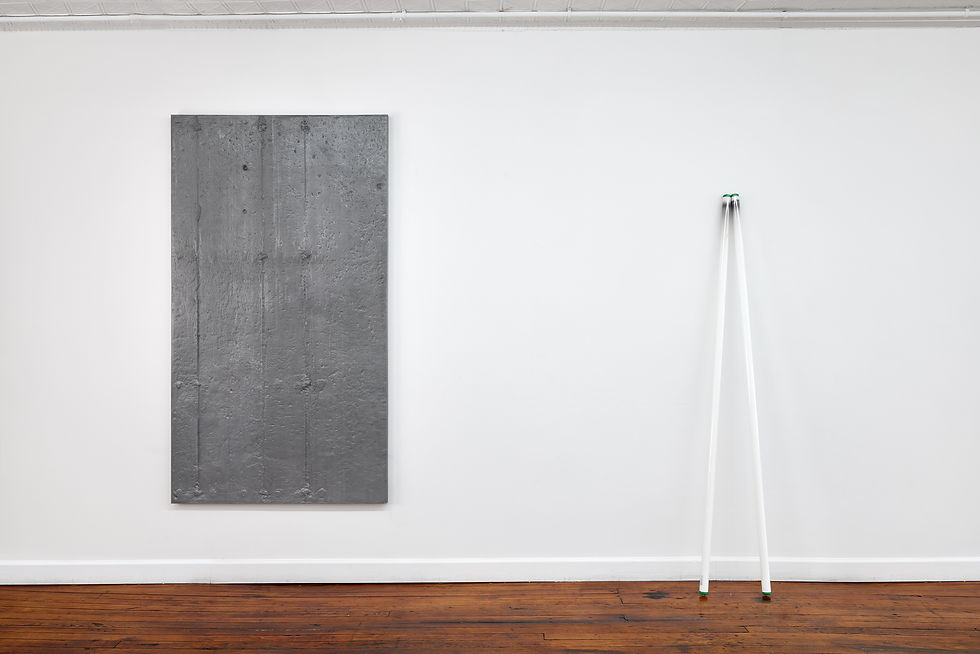
Installation view of “Mitchell Charbonneau: Remain” at Off Paradise, New York
Photograph by Marc Tatti. Courtesy of the artist and Off Paradise, New York
I do not usually walk through an exhibition with the artist. When asked, I generally decline. I tell the artist or gallerist that I do not need a guide. On those occasions when I do agree, it is usually because I already know the artist and their work, and such a walk-through becomes something closer to a studio visit. In the case of Mitchell Charbonneau, I knew the work and had only briefly met him once before. Knowing the work led to an invitation to continue our earlier conversation. An hour spent talking in the gallery largely confirmed my initial reading. Yet it is precisely the points of divergence that matter. The ability to disagree with the artist is what distinguishes criticism from art writing.
My task as a critic is to substantiate my interpretation. The artist’s task is to manifest their intentions both conceptual and subjective as fully as possible by whatever means available to them. My job is not to divine those intentions but to interpret what has become of them. These are distinct, though overlapping, forms of knowledge. The distance between them is productive. Neither the artist nor the work can opt out of the viewer’s comprehension. The exhibition’s title, Remain, signals this condition: remain as a verb indicates persistence; as a noun, what is left over. The title signals a refusal to choose between action and remnant. In Charbonneau’s case, that distance is marked by a recurring return to the relation between object, image, and re-presentation.
Organized around the reproduction of everyday objects through casting, carving, and surface intervention, Charbonneau’s earlier work operated through a procedural logic in which familiar forms were repeatedly reconstructed, indexed, and refigured. What persists is not iconic continuity but the persistence of a problem: negotiating the object’s status as replica, original, and re-presentation. In Remain, Charbonneau presents meticulously fabricated trompe l’oeil polychromed works that appear as burnt-out fluorescent tubes (Figure Study) implying it is the subject of observation and monochrome wall works that appear to be reliefs taken from sections of foundation wall (Foundations), which is an ambiguous reference to structural support, and historical grounding. With these works he eschews the logic of the found object and the Readymade, replacing them with their representation. In this respect the work operates closer to Jasper Johns than Marcel Duchamp. Like Johns’s painted bronze beer cans, Savarin with its paintbrushes, and sculpted metal flashlight, Charbonneau’s objects are not appropriations, but replicas: constructions made for display.
What emerges is more complex. These works move from concept to fabrication, but what emerges is neither simply object nor image. The clouded tubes are representations of burnt-out fluorescent bulbs. As fabrications, the bulbs never possessed the function they are depicted as having lost. There is a deadpan absurdity to this: a perfect replica of a burnt-out bulb that could never burn. With the bulbs the question of function is recalled. These works depict a failure that never occurred. At the level of image, the tubes mimic standardized industrial technology; at the level of object, they present themselves as modular structural units. The bulbs are life-size and appear to lean precariously against the gallery walls in differing arrangements and numbers; the wall fragments appear sectioned from standard foundations of stone or cast concrete. This scale ties each object to the viewer’s body and to the dimensions of actual fluorescent tubes and building walls. Any departure from that scale would alter the terms through which the object is recognized.


Mitchell Charbonneau, Foundation, 2026, Hammered copper, oil paint, 24 x 32 in.
Photograph by Marc Tatti. Courtesy of the artist and Off Paradise, New York
Mitchell Charbonneau, Foundation, 2026, Hammered lead, 24 x 24 in.
Photograph by Marc Tatti. Courtesy of the artist and Off Paradise, New York
Perceptually, the work moves between object and event, tool and sign, material and support. Structurally, it re-engages Minimalist and Post-Minimalist problematics not as historically resolved formations but as operative frameworks returned to circulation as conditions of re-entry rather than repetition. Johns’s objects and lead relief paintings, Minimalism’s modules, and Post-Minimalism’s attentiveness to situation and process are activated not as precedents to be cited but as parallel frameworks through which the same problem is rearticulated under different conditions. At the level of sign, the works circulate as an index of obsolescence. From this, a broad range of subjective associations may be generated. Each return to their legibility shifts the terms through which they are understood.
The wall pieces extend this inquiry into the terrain of painting. The wall sections are fabricated fragments whose status as cast or wholly invented is held in suspension. These works move between fact—weight, scale, material presence—and the pictorial—frontality, shallow relief, tableau-like presentation. They do not allow themselves to be read as found objects but insist on being encountered as skins, disembodied surfaces. This mismatch between apparent and actual material properties is operative throughout Charbonneau’s work. Their gouges, incisions, and marks function first as inscriptions and then as traces of making, shifting between signification and material fact without stabilizing as either. The reliefs are presented frontally, emphasizing their flatness less as a compositional device than as a mode of address. Within this field, trompe l’oeil no longer functions as illusion. There is no deception to sustain. Instead, it operates as a mechanism through which representation and re-presentation become difficult to distinguish.
The bulb and the wall fragment invoke the same architectural condition: both are fragments of a built environment. Across both, a recursive structure persists. Objects emerge at the point where practical use gives way to signification: a fluorescent tube that cannot light, a wall fragment detached from any structural role. Newly crafted surfaces assume the status of ruins, fragments, or archaeological remains without securing themselves as any of these. Repeatedly, Charbonneau returns to a limited vocabulary of objects and surfaces, passing them through the thresholds between utility and event, mark and inscription, object and artifact, the reasoned and the intuited. Here the work’s recursive logic becomes most evident. The represented bulb and the wall relief become two manifestations of the same structure: objects whose practical function has given way to signification. Repeatedly returned to circulation as image, object, and representation, they never stabilize as any one of these. What remains is not the object itself but the interval between these terms—a condition of suspension through which the work continues to generate meaning without resolving the conflicts from which it is formed.

Installation view of “Mitchell Charbonneau: Remain” at Off Paradise, New York.Photograph by Marc Tatti. Courtesy of the artist and Off Paradise, New York