

Meaning Aches
Threshold in Relations at Nguyen Wahed Gallery, New York / London
By Rui Jiang
Installation view of Threshold in Relations, Yuyu He, Zhaochen Chen, Aubrey Laduke, Courtesy of Christy Zhang and FanFlus
Afterimages form the fundamental unit of this exhibition. The signifier and signified of meaning are misaligned, delayed, and slide past each other, rubbing against the eyes and hearts to produce an overflow—this is the afterimage. The eyes become overloaded with images, turning sour, a faint ache arising from the cycle of meaning’s generation and collapse. Curator Yuxuan Fan begins with this raw, weighty curatorial impulse, evoking several wispy crosswinds through five artists’ critical practices. These breezes swirl around those present, ambushing repeated slips of perception and attempts to climb back up—the path slippery, greasy, intimidating, yet snuggly. Through these reversals and reinventions, relations are forced out.
It also feels as though the exhibition itself has entered a state of stain, clenching its teeth amid the mutual erosion between meaning’s forced brightness and the sky’s refusal to brighten, stifling the glare. Yuxuan Fan situates the viewer directly within these perceptual thresholds, where the meaning dims, flares, and falters. Equally glaring is the allegorical identity of meaning itself—or rather, a perpetual import. When meaning settles upon concrete bodies, this imported meaning and the emotions within the gut inevitably entwine, giving birth to an “obscurity” that is both more intimate and estranged. Under the probing of matter and the knocking of spirit, the exhibition grows ambitious: it lays bare a cold yet entangled declaration through the works’ challenges to the limits of cognition, and through its witnessing of the negotiation between a priori assumptions and experiential reconstruction. Meaning, here, is both a draught and a hollowed-out shell.
Thus, the works shield one another and betray one another: highly saturated color schemes in the depths of the eye; organ-less structures dismantle themselves within the nerves; allegorical images ferment in a half-lit, half-fading glow; the mirrored self tears open only to be sutured again; a mechanical body hangs in suspension like a verdict left unfinished. Fan’s threshold-oriented curatorial structure presses sensitivity down to a line that nearly grazes the ground, allowing relations to be born in the space between extremely tiny stimuli and sudden perceptual shifts. It is a forced re-arrangement: you try to remain composed.
The exhibition begins at a kind of fused-break point in the spatial logic. Yuyu He’s sculpture Sha, sha, sha strips everyday space of all its reliability, leaving only the phantom of a supporting structure. Order leaks its brittleness, and as you walk around it, space slips away from the coordinate system you once assumed stable, becoming a “temporary reality” you must learn anew. You step into a different relation, sensing subtle curves and gaps with your body. The chiffon fabric, lightly trembling in the air, seems to whisper that when perception collapses, understanding may finally appear.
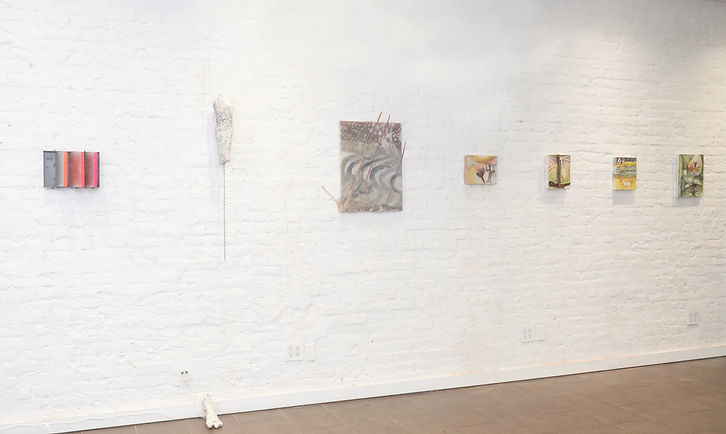
Installation view of Threshold in Relations, Zihan Cui, Zhaochen Chen, Yuyu He, Xiaohan Jiang, photo by Christy Wang and FanFlus
Moving inward, in Aubrey LaDuke’s self-portraits, the face is fractured, bent, sutured. She stages a confrontational exercise using her own visage: to stare back, to doubt, to tear, to mend. “Self-portrait” is pried open from its traditional function of self-affirmation, revealing instead a subject that is becoming—one that can never fully seal—and a kind of defamiliarized kinship. Viewers standing before her work feel an unease: you think you recognize her.
Zihan Cui’s color-block sculpture “A” person’s life resembles steel in the throes of combustion, as if color has seized dominion over materiality in an instant. Yet as the forms advance toward the eye, they culminate in a sudden, oversaturated visual vertigo. Color serves as Cui’s tool for spatial experimentation; the afterimages imprinted beneath the eyes by saturation physically engineer moments of sensory uncertainty. They sever expectations of the image’s representational function, creating a chase, a slip, and an inescapable tension between the act of viewing and the shifting space.
Xiaohan Jiang’s paintings, as mentioned earlier, resemble an allegory that refuses to dawn. She lets poetics become a sliding medium—neither guiding nor explaining, but running back and forth between signifier and signified. Her imagery never volunteers clarity, yet in the most unguarded moments it shakes loose small, piercing flashes of lucidity. What Jiang constructs is a “slow approach of meaning,” and relationships quietly take shape within this meaning that is never allowed to settle. You stumble, you recalibrate, you move forward.
Zhaochen Chen’s works inhabit various corners of the space. What Chen constructs is not the image of dismembered organs, but a turbulent system composed of excess desire, memory, and flesh. They spill, twist, disintegrate, and reassemble. Her practice presents a portrait of the posthuman—recursive, affective, materialized—where the grotesque, the mechanical, and the bodiless together constitute the subject’s formation and deformation. Through a state of nearly untouchable suspension, she compresses “existence” into a kind of hesitation.
The artist’s subtle plotting, the curator’s quiet complicity in the motives, tighten into a trembling rope on which the viewer must inch forward. In their back-and-forth, the signifier and the signified are worn to a shine, scraping up patch after patch of unease. You have not yet named it, yet it renames you; you attempt to organize, yet it organizes your hesitation. Through the fissures of liminality, a gentle crosswind still blows—it’s time to observe our own dependence on how you watch. How do we relinquish control?


Images: Curator Fanfan Yuxuan FAN, courtesy of Christy Wang and FanFlus and Installation view of Threshold in Relations, Zihan Cui and Zhaochen Chen, courtesy of Christy Wang and FanFlus