

OHDO’s
Totems of the Romantic Sublime
Flower King, 29.8x22cm, ink, acrylic, paper, canvas on panel, 2026 - by OHDO
At the Asian & American Art Foundation, New York
by Dr. Thalia Vrachopoulos, May 1, 2026
A quick survey of the current exhibitions in Chelsea demonstrates a renewed commitment to color, figuration, and a violent expressionist vocabulary suggesting a perceptible retreat from the former austere grammars of contemporary minimalism and the often-hermetic logic of conceptual installation practices that have largely governed the last decade.
What emerges instead is a renewed reassertion of painting as a sensuous, expressive, and psychologically saturated medium. This tendency finds a particularly cogent formulation in Elizabeth Peyton’s recent presentation at David Zwirner, where her ethereal portraits dissolve into a fluid energetic tonality, recalling the mystical chromaticism of Mikhail Vrubel and the broader symbolic inheritance of late Russian Symbolism. A related atmospheric charge permeates the group exhibition Innocence and Intruders at Fredericks & Freiser, that recalls the febrile corporeality of Egon Schiele. But this show is imbued with something unmistakably drawn from the haunting, moral terrain of William Faulkner’s American backwaters. Empty bedrooms, rugged fields, eerie dollhouses, and dense thickets of shadow and saturation silently dissolve wherein the domestic and the pastoral seem thickened by a threatening undercurrent of uncanny tension.
Of particular interest is Younseok Oh (a.k.a. OHDO): Hidden Memories – Romantic Sublime, a solo show at the Asian & American Arts Foundation, a new Chelsea space. If the surrounding galleries signal a renewed investment in expressionism and painterly intensity, Oh’s work proceeds along a more rarefied and mystical trajectory. Drawing from a prolific career that includes twenty-seven solo exhibitions and over one hundred group presentations since his debut in 2003, Oh has cultivated a remarkably protean and multifaceted praxis, persistently interrogating the conditions of human nature and the possibility of artistic healing. Central to this inquiry is his self-conscious pursuit of the figure of the contemporary shaman, a position that was already recognized in 2005 when his work was presented in “Six Korean Contemporary Artists” at Art Center Silkeborg Bad in Denmark and celebrated as a form of Korean shamanistic art.
In a way, Oh’s practice finds its most profound theoretical exigency when situated within the delimited framework of shamanism researched by Mircea Eliade. Eschewing the nebulous taxonomies of the generic magician or sorcerer, Eliade posits the shaman as a highly specialized technician of the sacred; a psychopomp uniquely empowered to traverse ontological thresholds and facilitate an ecstatic passage between the empirical and the invisible. Oh’s work does not merely inhabit these motifs as a superficial aesthetic; rather, it reactivates this mediatory logic, positioning the canvas as a structured site of a cosmogonic dialectic.
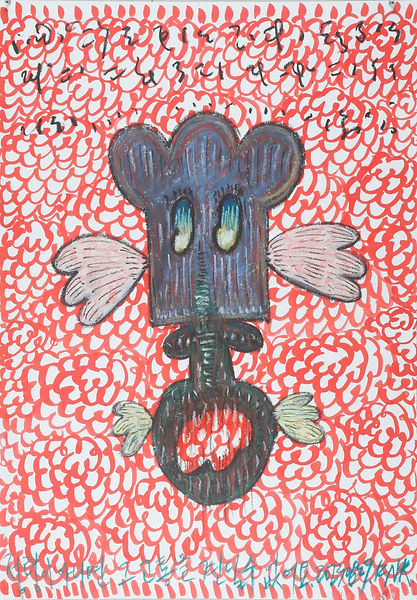
Peace Please _ If it's not a spirit, we can't bear the pain, 100x70cm , ink, oil pastel, oil bar on paper, 2023-by OHDO

Peace Please _ If it's not a spirit, we can't bear the pain, 100x70cm , ink, oil pastel, oil bar on paper, 2023-by OHDO
Oh’s Peace Please series, mobilizes a reductive, almost childlike visual language that at first recalls the immediacy of Art Brut and naïve iconography yet quickly reveals a far more charged ritual intentionality. Evoking both the cosmological symbolism of Hopi ceremonial imagery, the primitivist investigations of Natalia Goncharova, and Korean folk painting, these raw icons coalesce around mask-like up-right and frontal bust images. The distorted features of these totemic heads, seem caught in a field of visual interference, as though disrupted by static, and are dominated by abstract red ovals roughly worked with natural dye, that appears to make them vibrate with restless intensity. Yet, these folk totems do not merely depict spirits; they channel them, their contours trembling, fragmenting, and reconstituting as if transmitting the unseen. The abrasive materiality of oil stick and pastel amplifies this otherworldly sense of vibration; energy seems to radiate outward from the cranial forms, circulating between the head as locus of consciousness and the surrounding reddish world-space. Thought, spirit, and matter are made to collapse into a single pulsating field. The artist’s recurring motifs in the series Peace Please, as well as in Hidden Memories draw upon jangseung, the carved totemic posts traditionally placed at Korean village thresholds as apotropaic guardians. But, in this context, they become vertical presences that anchor the compositions within a cosmic system of protection and liminality.
Simultaneously, Oh’s sustained and technically sophisticated engagement with Hanji, positions him, as a master paper artist deeply rooted in Korean material and pictorial tradition. Trained in the painting style of Minhwa (whose symbolic repertoire encompasses tigers, mountains, temples, pojagi textiles, and scholarly interiors) his practice both inherits and transforms this vernacular idiom. Earlier series emphasized the twisting and extrusion of the paper surface, with protruding fibres delicately tinted at their extremities in restrained tonalities of grey, deep blue, and sanguine. In his more recent works the gesture becomes incisive rather than accumulative, as he cuts into the paper with meticulous precision, generating fields of minute chrysanthemum-like forms whose subtle relief barely emerges from the flat surface. Oh’s engagement with Korean hand-made Hanji reaches a particularly refined articulation in the Flower King series. Here the surface of Hanji paper becomes a field of minute incisions and subtle reliefs, generating delicate proliferations of petal-like formations whose rhythmic dispersion recalls a biomorphic mode of non-objective painting. Rather than presenting the peony as a descriptive botanical motif, Oh allows the flower to emerge through the very structure of the surface, as though the paper itself were slowly flowering into form. Interpreted through a shamanic notion in which natural phenomena are understood to contain latent spiritual energies, the peony assumes a symbolic charge associated with fire; an element traditionally linked to purification, transformation, and cyclical renewal.
Ultimately, Hidden Memories – Romantic Sublime functions as a definitive coda to the current pictorial zeitgeist defining Chelsea’s contemporary circuit. While the surrounding galleries largely oscillate within a renewed fascination for a vivid objective formalism, Oh’s intervention avoids the pitfalls of mere stylistic revivalism. Instead, he orchestrates a radical departure from the traditional canvas, propelling the animated energy of contemporary painting into a more complex, tactile dimension through his masterful manipulation of Hanji. By treating this traditional medium as a site of sculptural incision and luminous depth, Oh transcends the static nature of pigment, allowing the chromatic intensity of a romantic sublime to breathe within a three-dimensional field of hidden memories.

Hidden Memories 2401-2402, Ink Acrylic, Color Pencil, Oil Pastel on Paper on Canvas on Panel, 45.5x38cm, 2024-By OHDO