
A Room Rehearses
On Its Own
A makeshift home forms in Latitude Gallery through Rebecca Wu's assertive oil stills
By Aliza Katzman, April 24, 2026
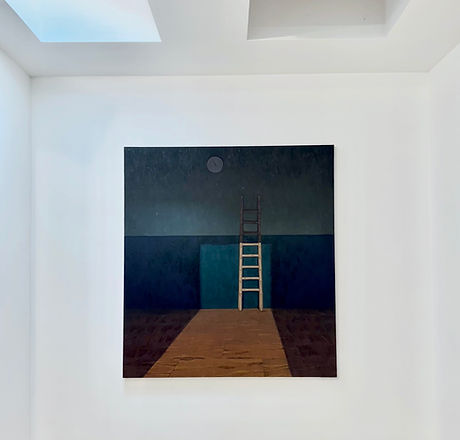
Letter to Time, Oil on Canvas, 55 x 60 in, 2025
A Room Rehearses On Its Own is an apt name for Rebecca Xiangjie Wu’s solo show, where everyday objects like bowls, shoes, and mirrors assert themselves as the main characters of her oil paintings. Figures feature rarely in this body of work, but when they appear, they are treated as a part of the scenery rather than a distinct occupant. The works, rather than carrying the vitality of typical nostalgia, are closer to the stillness of preservation.
This is Wu’s second show and first solo show with Latitude Gallery, a Tribeca-based gallery focused on highlighting emerging artists and AAPI voices in the arts. Walking up the stairs, the first thing a visitor may encounter is an excerpt of a Louise Glück poem on the wall, immediately to the right of the entrance. Invoking the constant recollection and re-imagination of childhood, Gluck writes of “silence and distance, distance of place, of time”. It was well-chosen for this show, which has processed all Wu’s memories equally through a textured, blue and lavender haze: those older and newer, those farther away in China and right here in Brooklyn.
A former Philosophy major, Wu seems to offer the intellectual counterpart to the saying “the body keeps the score”: that our constant reinterpretation of memory is, ironically, our only means of keeping it with us. What results is a show that seems to assert that change is as essential to returning as it is to moving forward. It feels analogous to me to a scientific paradox: the process of observing itself influences the result of one’s observation. The process of dredging up memories requires reinterpretation. I think of the James Baldwin quote from his novel Giovanni’s Room: “You don’t have a home until you leave it and then, when you have left it, you never can go back.”
Wu’s interest in Morandi, film, and the cool-toned filter distinctive to the blue windows of her childhood home in rural Southern China all converge in her work: carefully curated snapshots, accumulating both space and time as they construct scenes from Wu’s life.
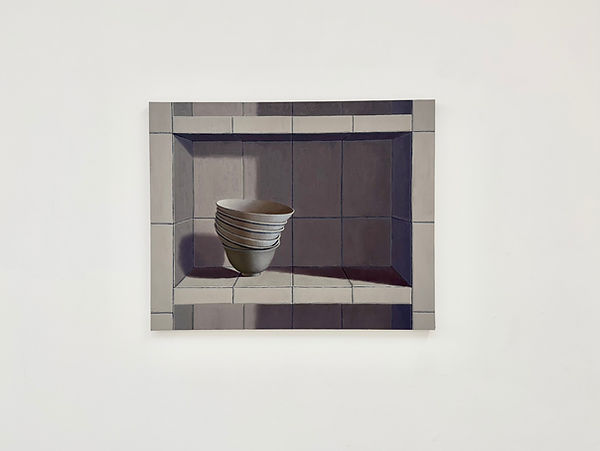
Bowls VI, Oil on Linen, 24 x 30 in, 2025
A trademark of Wu’s work, which I attribute to her interest in cinematic composition, is her ability to mimic the natural movement of the eye and weave it together with both the simplifying and romanticizing effects of memory. Stepping into Latitude Gallery, a bisected room and a scattering of furniture creates a makeshift interior space in which Wu’s body of work thrives.
The gestalt of this show is helped greatly by the thoughtful curation of Xiaojing Zhu, who is familiar with Wu’s work and has worked with her in the past. Zhu plays with the interior nature of the work, placing small paintings of shoes closer to the ground and near the entrance of the gallery, and hanging a large depiction of a wall on the temporary wall bisecting the typically open gallery space. It is playful, but also literal, and supports the experiential nature of viewing Wu’s paintings.
The addition of two chairs and a desk toe the line of installation, heavily implying the room without outright asserting it. It is Wu’s paintings that do the heavy lifting, depicting closets, shelves, windows, and mirrors. In the back corner of the gallery, a painting of Wu discovering a ladder in an apparently empty room sits beneath a skylight and a vent going into the ceiling; it seems almost as if the ladder is really there leaning against the wall, and that one could use it to climb up into the ceiling to explore whatever is up there.
In between each canvas, the white walls of the gallery fill in hundreds of other moments connecting these memories to each other. Much like the jumble of our own memories (or perhaps just mine, reliably unreliable and as organized as Chex Party Mix) these memories are not connected by chronology or by hierarchy; this flattening of time becomes a facsimile for the present self, a simultaneous product of every equal moment. Thus, with a little imagination, the gallery we walk through is able to become a physical manifestation of Wu’s reminiscence.
As we look at Wu’s paintings, we are clearly looking through her eyes, something especially obvious in works depicting her family or her own reflection. As she welcomes us without pretense into the realm of her personal memories, some displacement occurs: in most of her work, her physical body is absent. She is both inside of the memory and removed from it, and so we take on the role of observer, catching glimpses of her reflection from time to time as we stand where she once stood.
This seems to reflect some kind of wall between Wu and her own memories, something I see reflected in the treatment of figures in her work: A boy pulls a shirt over his head, forever frozen as a faceless, armless torso. A girl appears in a mirror, but her body is nowhere to be seen. A woman’s fingers lightly grasp mahjong tiles, but in this work texture is all that differentiates skin from smooth ceramic. Those who occupy these memories are not necessarily having their stories told, we are simply seeing what Wu has seen.
Her treatment of inanimate and animate subject matter equally highlights a clear acceptance of the past as past: these memories are not functioning as sites for attempting to relive her childhood, rather, they are highly visual moments worth preserving in of themselves.
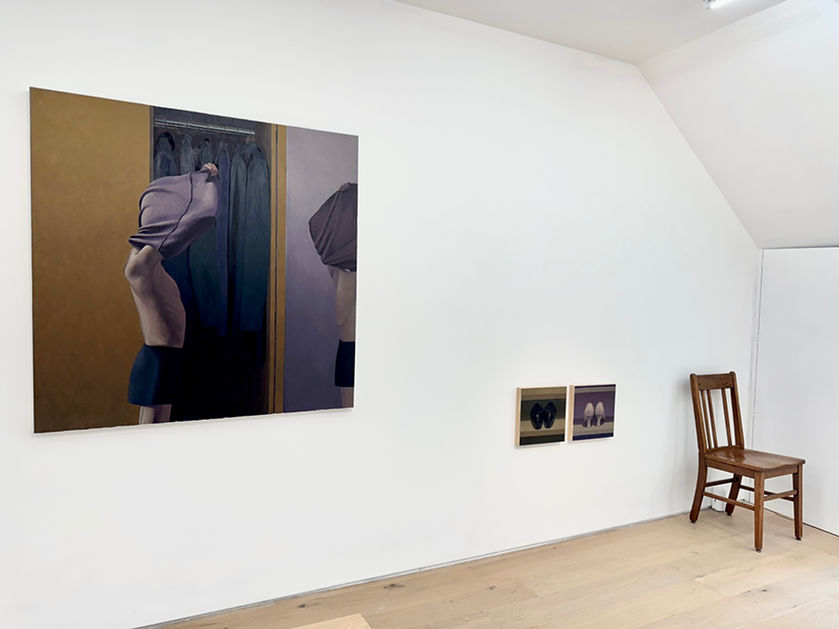
Installation shot, A Room Rehearses On Its Own, Latitude Gallery
This seems to reflect some kind of wall between Wu and her own memories, something I see reflected in the treatment of figures in her work: A boy pulls a shirt over his head, forever frozen as a faceless, armless torso. A girl appears in a mirror, but her body is nowhere to be seen. A woman’s fingers lightly grasp mahjong tiles, but in this work texture is all that differentiates skin from smooth ceramic. Those who occupy these memories are not necessarily having their stories told, we are simply seeing what Wu has seen.
Her treatment of inanimate and animate subject matter equally highlights a clear acceptance of the past as past: these memories are not functioning as sites for attempting to relive her childhood, rather, they are highly visual moments worth preserving in of themselves.
In terms of technical execution, her matte palette and neat brushstrokes give her paintings a matter-of-fact quality, while her consistent color choices clearly situate each work within a larger catalogue of nostalgia. At times, her heavily textured brushstrokes appear to be a compromise between the stylistic and the utilitarian, as she fills in the large swathes of doors, floors, and walls which feature in so many of her compositions. She has a habit of omitting extraneous detail, another element of her extremely focused compositions. The effect of this is a body of work that asserts existence over meaning; while Wu creates ample space for the viewer to see through her eyes, these compositions of still objects and frozen moments in time provide us with little insight or context as to why we are looking at the subject.
It is for precisely this reason that Wu’s invocation of memory is so successful: while there is perhaps little reason for which every day moments compel our gaze to linger, or why our memory catches on any particular brief glance, the accumulation of these small moments of “noticing” are a fundamental part of our individual humanity. That is, both noticing our surroundings and situating ourselves within them.
A Room Rehearses On Its Own is open now through April 26, 2026 at Latitude Gallery, 5 Lispenard St and open Tues-Sat from 12PM - 6PM.