
When Sustainability Becomes a Bridge to Connect Hearts
By Sherly Fan, July 6, 2026
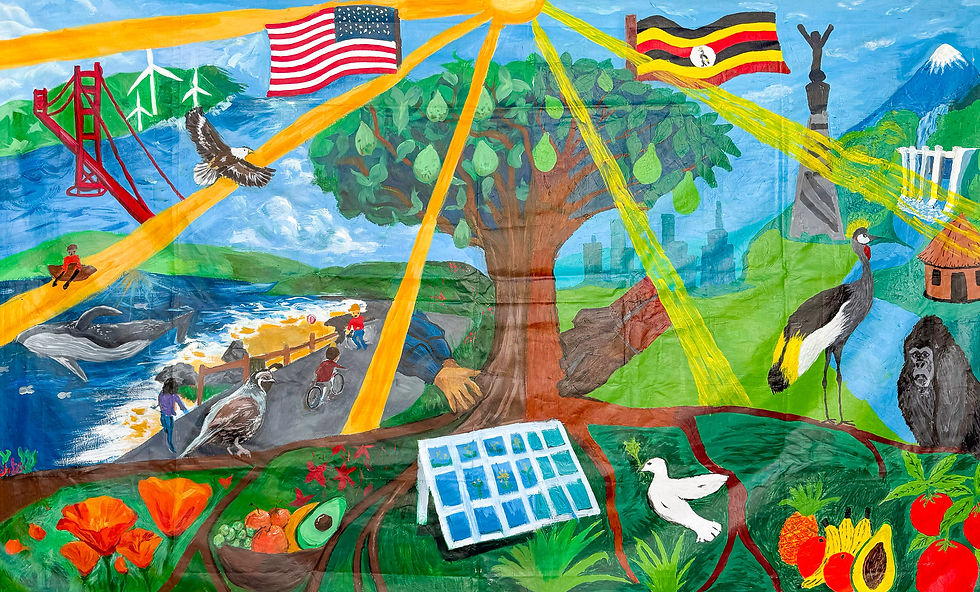
mural for VESSEL. Courtesy of the artist.
A special pop-up show at the Stanford University Department of Global Ecology, VESSEL: An Exhibition on Sustainability, Community, and Our Shared Future, curated by Yilin (Rebecca) Sun, offers a gentle and relational perspective on sustainability. Rather than viewing sustainability only as a solution to environmental issues, Sun views it as a vessel to connect people and bring people together. She views sustainability not as a result we need to achieve or a destination we need to arrive at, but as a shared practice we carry with us. It becomes something that connects us while we collectively imagine and work toward building a better future.
This show includes works that are either contemplative reflections on time, how our past impacts the current status quo and how it may shape our future, or works that invite nuanced observations on sustainability in our daily life. These two different angles challenge us to review how we handle the very broad subject and word “sustainability.” It is a term that sometimes feels overused and numbingly flat, as if it has lost part of its meaning.
Yellow Peril by Joyce Zhang and Transmission by Jonny Tang, together with A Gateway in the Lenses by Kathlyn Zhang and Childhood Cotton Candy by Olivia Xia, become two pairs of paintings trying to discuss how our past shaped the current sustainability landscape. In the first pair, both paintings use fluid paint materials to capture the ambiguity and movement of the past shaping now and the future. The second pair, at the same time, contains text cut-outs, collage elements, soft candied color palettes, and subject matters that seem to hold on to a simpler past.
The contradiction between the two pairs indicates how hard it is to completely resolve and view sustainability currently. One side suggests movement, instability, and historical residue; the other suggests nostalgia, sweetness, and the desire to preserve something already slipping away. It is a mixed-feeling experience, where it seems like we are moving forward, yet we also forever lose something we can no longer grasp onto.
Carrying Growth by Chenglin Zhu and Whispers of Gentle Tea by Kai Lu offer a kind of magical escape. A living vine grows out of a ceramic hand in Carrying Growth, while Whispers of Gentle Tea is a teapot and teacup set with eyes like fugu fish, inspired by the films of Studio Ghibli. Both ceramic works break the boundary between daily objects and living organisms. They seem to imply that maybe we need a little magic to break through and move forward.
While Landscape with the Two Sponges, Spring by Yijia (Jerry) Sun indicates that maybe the magic already lies in our daily mundane life. At first glance, this work looks like an abstract spring landscape photograph, but it is actually a micro-photograph of the surface of a scrub sponge. Sun is trying to show us that maybe if we shift our attention in a small way, it could open our eyes to new ecological imaginations.
%20Sun.jpg)
Landscape With Two Sponges, Spring, Yijia (Jerry) Sun, image courtesy of the artist
This exhibition also unravels a very special collectively made mural project for VESSEL. It began with half of the painting done by students in Uganda and was finished live by students in Silicon Valley. The painting depicts how local nature is harmoniously coexisting with local landscapes. In the half completed by the Ugandan students, cranes and gorillas exist together with houses and buildings, fruits and greens. The pigeon at the bottom indicates their wish for a peaceful and sustainable future.
The Silicon Valley students finished the painting with the Golden Gate Bridge, an eagle, a whale, and humans by the sidewalk of the ocean. In the center of the painting, hands from different continents are collectively growing one tree, surrounded by sustainable energy elements including solar and wind power systems.
The language and elements in the work may be simple, but it genuinely reveals how the younger generation is imagining the future based on our current conversations and development around sustainability. Maybe this simplicity is also part of the point. It does not present a mature or fully resolved image of the future, but it shows the honest symbols people still reach for when they are trying to imagine care, peace, nature, and a better world.
Rather than presenting us with a mature conversation toward sustainability, Sun instead offers a genuine conversation on how we can become vessels for these issues. Rather than insisting on finding the solutions, maybe the act of sustainability itself, and the process of imagining and working for a better future, is what connects us and makes a difference. This unresolved quality is not necessarily a weakness to hide, but part of what the exhibition reveals: sustainability remains a broad and difficult language, one that many people are still learning how to translate into concrete forms and shared actions.
Sherly Fan is a writer and artist who received her MFA from Duke University. Drawing from her background in experimental documentary, performance art, and her ongoing exploration of “cute studies,” she approaches the art world with directness, honesty, and a sense of openness. Her writing is guided less by answers than by questions—philosophical, rhetorical, and reflective—inviting multiple ways of seeing and understanding.

Carrying Growth, Chenglin Zhu, image courtesy of the artist